
PlantFlow 3D › Simulators › DOL Starter Simulator
DOL Starter Simulator: wire and test a direct-on-line motor starter online
Free DOL starter simulator. Wire QF1, KM1, F1, START and STOP yourself, watch the current flow, test the overload and find faults. Works on phones.
▶ Open this simulator ⬇ Download the app
What it is
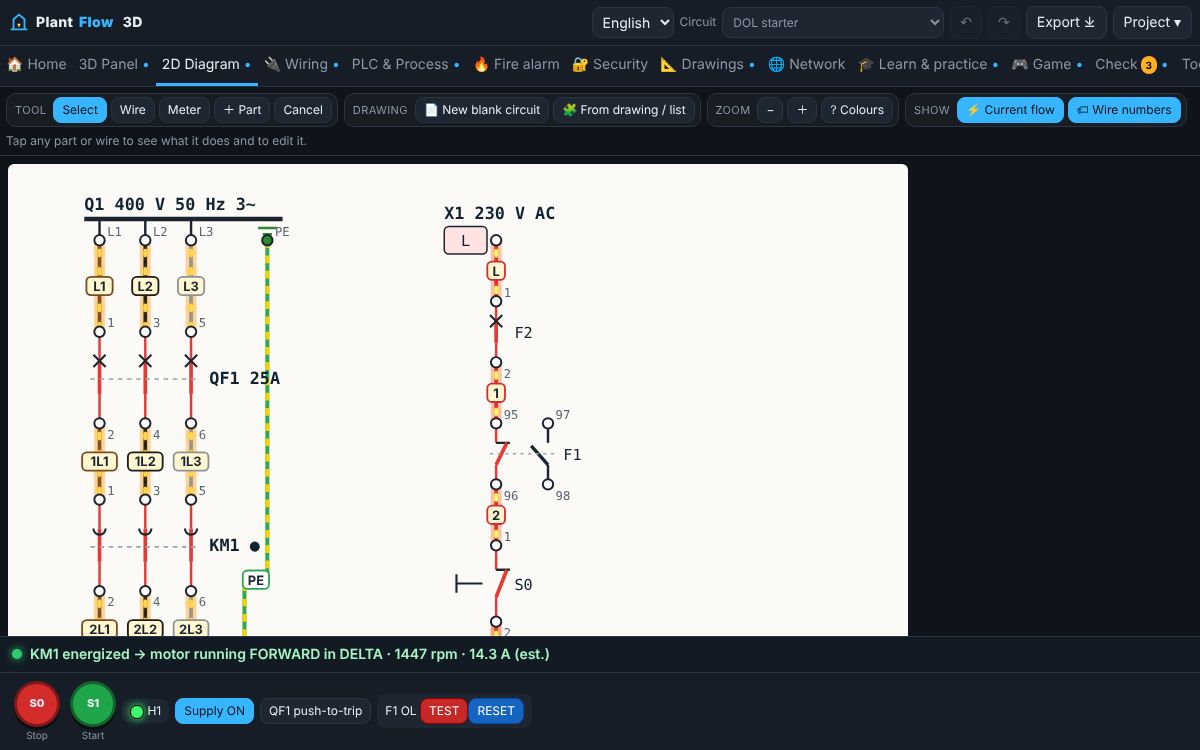
The DOL (direct-on-line) starter is the first motor circuit every electrician learns. In PlantFlow 3D you build it yourself: the MCCB QF1 feeds the contactor KM1, the thermal overload F1 protects the motor, and the control circuit runs from the control supply through STOP (NC), START (NO) and the hold-in contact 13-14 to the coil A1-A2.
What you can do
- Wire the power and control circuits terminal by terminal; wrong connections are explained at once, including short circuits.
- Press START and STOP and watch the hold-in contact keep the coil energised.
- See the motor current on every power wire: about 14 A for the 7.5 kW example and roughly six times that during starting.
- Press TEST on the overload relay: 95-96 opens, 97-98 closes and the motor stops.
- Find hidden faults with the multimeter and the voltage trace.
How to use it
- Open the simulator and choose the DOL starter (it opens automatically from the button below).
- Turn on Current flow and Wire numbers in the 2D diagram.
- Press START, then STOP, and read the status line.
- Open Home → Practical lessons → DOL motor starter to wire it yourself and get a score.
Learn the theory
- How a DOL motor starter works
- Overload relay contacts 95-96 and 97-98: test, reset and setting
- Contactor terminals explained: 1-2, 3-4, 5-6, A1-A2, 13-14 and 21-22
- Motor full-load current and overload settings
Questions
Is the DOL simulator free?
Yes. It runs in the browser with no account and no payment.
Does the simulator show the real starting current?
It uses a deterministic motor model: starting current is several times the full-load current and falls as the motor reaches speed. Real values depend on the motor; use the nameplate for settings.
Safety: this guide explains principles for learning. Real installations must follow the applicable codes, the equipment manufacturer's instructions and the approval of a competent, qualified person. Isolate, lock off and prove dead before touching any circuit.