
PlantFlow 3D › Simulators › Star-Delta Starter Simulator
Star-Delta Starter Simulator: see the star to delta changeover
Free star-delta starter simulator with KM1, KM2, KM3 and timer KT1. Watch the motor start in star at about one third of the DOL current, then change to delta.
▶ Open this simulator ⬇ Download the app
What it is
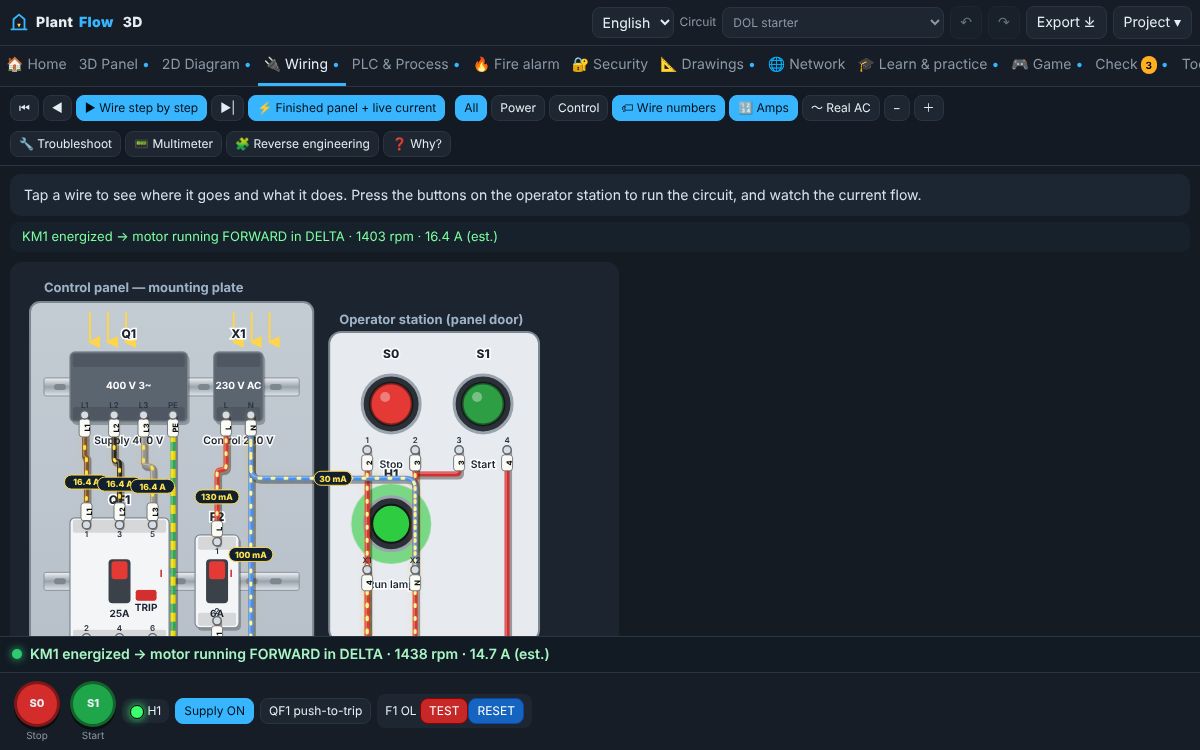
A star-delta starter reduces starting current by connecting the motor windings in star for the first seconds and then switching to delta. The simulator models the three contactors, the on-delay timer and the electrical interlock between the star and delta contactors, so you can see exactly when each contact changes and how much current flows.
What you can do
- Watch the star contactor drop out and the delta contactor close when the timer runs out.
- Compare starting current in star with a DOL start of the same motor (about one third).
- Check the six motor cables U1 V1 W1 and W2 U2 V2 in the wiring view.
- Prove the interlock: the star and delta contactors are never energised together.
- Practise with the star-delta lesson and hidden faults.
How to use it
- Open the star-delta circuit with the button below.
- Press START and watch the status line change from STAR to DELTA.
- Use the clamp meter on a supply wire to read the line current.
- Open the Check tab to see the interlock rules.
Learn the theory
- Star–delta starting explained
- Contactor terminals explained: 1-2, 3-4, 5-6, A1-A2, 13-14 and 21-22
- Overload relay contacts 95-96 and 97-98: test, reset and setting
- Troubleshooting a motor control circuit step by step
Questions
Why does star-delta reduce starting current?
In star each winding receives the phase voltage (about 58 % of line voltage), so line current and torque fall to roughly one third of a DOL start.
Where is the overload relay set in star-delta?
Usually in the main or delta line carrying phase current, so it is set to about 58 % of the motor line current. Check the drawing of the actual starter.
Safety: this guide explains principles for learning. Real installations must follow the applicable codes, the equipment manufacturer's instructions and the approval of a competent, qualified person. Isolate, lock off and prove dead before touching any circuit.